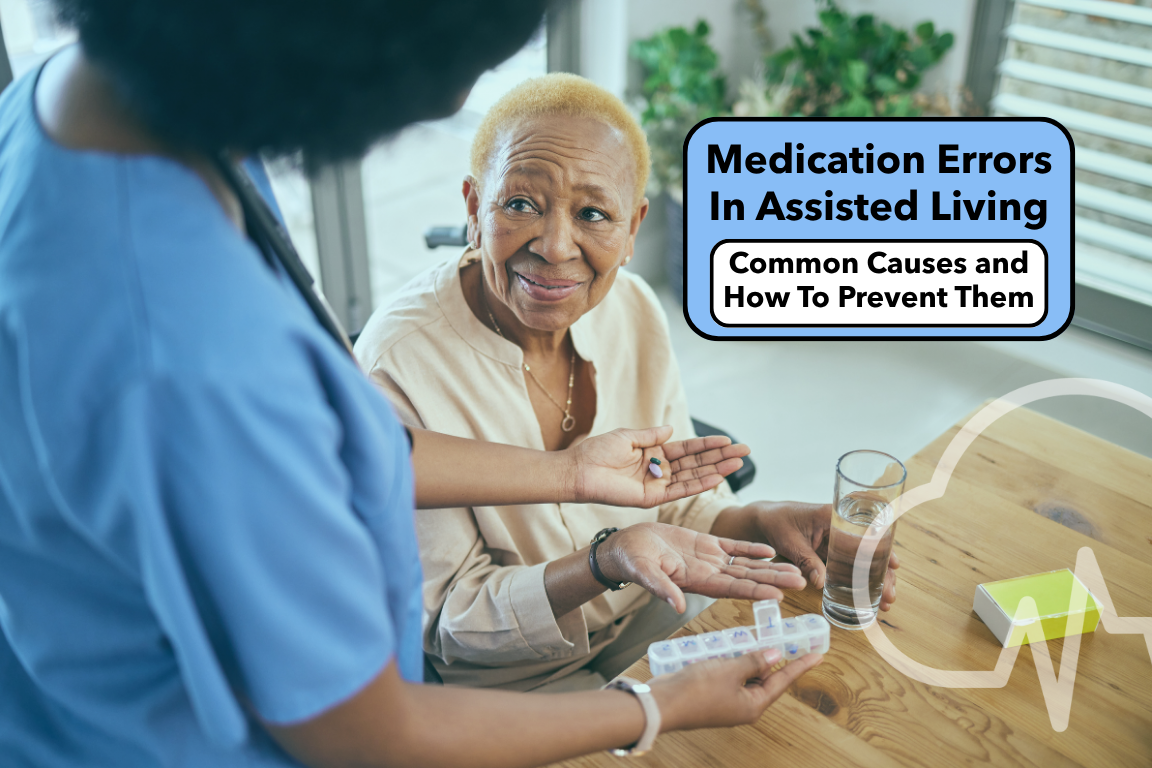
Medication mistakes are one of the most preventable risks in assisted living communities. Whether you operate a small residential care home or a large facility, even minor errors in medication management can lead to resident harm, citations, and serious legal exposure.
Fortunately, these mistakes are highly avoidable. By creating consistent systems, training staff, and using modern documentation tools, providers can greatly reduce risk and support better outcomes.
This guide breaks down the most frequent causes of medication errors in assisted living and provides simple, effective ways to prevent them. It is designed to help both new and experienced providers build safer communities through better medication practices.
What Is a Medication Error in Assisted Living?
A medication error is any preventable event that causes inappropriate medication use or puts a resident’s health at risk. Errors can occur at any point in the medication process, from prescribing and transcribing to administering and documenting.
According to the U.S. Department of Health and Human Services Office of Inspector General, one in three residents in skilled nursing facilities experiences an adverse event during their stay. Of those, 37 percent involve medications. (OIG, 2014)
The Centers for Disease Control and Prevention (CDC) also reports that adverse drug events result in more than 1.3 million emergency department visits each year, and adults aged 65 and older are among the most affected. (CDC, 2024)
The Most Common Medication Errors in Assisted Living
Here are the most frequently reported types of medication errors in assisted living settings:
- Missed doses
- Wrong dosage given
- Incorrect medication
- Wrong resident received medication
- Medication given at the wrong time
- Incorrect route used for administration
- Errors in documentation
Even if no harm occurs, each of these errors can create compliance issues or lead to serious outcomes if repeated over time.
Why Medication Errors Happen in Assisted Living
Inconsistent Medication Procedures
When there are no standardized routines for med passes, PRN documentation, or handoffs between staff, mistakes become more likely. Each staff member may approach tasks differently, leading to preventable confusion or missed steps.
Inadequate Staff Training
Team members may not fully understand drug interactions, documentation protocols, or how to handle high-alert medications. This is especially risky in communities with frequent staff turnover or limited onboarding processes.
Poor Communication Between Shifts
If outgoing and incoming shifts do not clearly communicate about PRNs given, med refusals, or new orders, medication changes may fall through the cracks. Verbal handoffs alone are not reliable.
Paper MARs or Disorganized Documentation
Paper-based medication records are often incomplete, difficult to read, or filled out incorrectly. Even digital systems can cause problems if staff are not trained or if the system lacks alerts or audit trails.
High-Risk Medications Without Safeguards
Certain medications like insulin, opioids, warfarin, and digoxin carry a higher risk of harm if used incorrectly. The Institute for Safe Medication Practices (ISMP) classifies these as high-alert medications in long-term care settings, recommending additional precautions such as staff training, auxiliary labeling, and independent double checks for administration (ISMP, 2021).
How to Prevent Medication Errors in Assisted Living
1. Standardize Medication Procedures
Write clear step-by-step protocols for:
- Daily medication administration
- PRN medication tracking and outcome notes
- Shift handoffs and med change alerts
- Procedures for missed or refused doses
Train every staff member on these routines and keep them easily accessible in digital or print formats.
2. Provide Regular Staff Training
Medication safety is not a one-time lesson. Provide:
- Initial onboarding training on med administration and documentation
- Annual refreshers that include error prevention best practices
- Education on new or high-risk medications
Use real-life examples or case studies to reinforce learning.
Tip: Encourage staff to ask questions or report confusion. A proactive question is better than a silent mistake.
3. Use a Reliable eMAR System
Electronic Medication Administration Records reduce manual errors, improve documentation accuracy, and help flag missed or overdue doses. Look for features such as:
- Real-time medication alerts
- PRN tracking with outcome fields
- Easy-to-read visual schedules
- Audit-ready reports for compliance
Synkwise offers a user-friendly eMAR system designed for assisted living providers. It helps staff stay organized, prevent errors, and maintain compliance with confidence. Learn more here!
4. Create a Structured Shift Handoff Process
During every shift change, staff should document and communicate:
- PRNs given and the outcome
- Any refused or missed medications
- Changes to medication orders
- Pending pharmacy deliveries or clarifications
Use written logs or shared digital tools so no detail is forgotten or miscommunicated.
5. Flag High-Alert Medications
For medications like insulin or warfarin, set additional policies such as:
- Double-checking with a second staff member before administration
- Color-coded storage labels
- Separate medication bins or blister packs
Educate staff on why these medications require extra care.
6. Conduct Regular MAR Reviews
Supervisors should review a sample of MARs each week for:
- Missed signatures
- PRNs without documentation of reason or outcome
- New orders not yet entered
- Unusual medication patterns
Address any gaps through coaching or process updates.
7. Build a Culture of Safety
Create an environment where staff feel supported in reporting near misses or asking for help. Use mistakes as learning opportunities, not punishments.
Bonus tip: Recognize teams for successful med passes, accurate audits, or improvements in documentation. Positive feedback reinforces good habits.
How Common Are Medication Errors in Assisted Living?
A study published in the Journal of the American Geriatrics Society found that up to 40 percent of med passes in assisted living involve an error. About 7 percent of those errors have the potential to cause harm. (Zimmerman et al., 2011)
Even if no resident is harmed, the frequency of errors underscores how important it is to have a prevention strategy in place.
Final Thoughts
Medication safety is one of the most critical responsibilities in assisted living. While not every error results in harm, even one mistake can lead to serious consequences for the resident, the caregiver, and the community.
The good news is that with the right systems, consistent training, and user-friendly tools, providers can prevent most errors before they happen. You do not need to be perfect, but you do need to be proactive.
Want to Simplify Medication Management?
Synkwise helps assisted living teams manage medications with clarity and confidence. With built-in alerts, audit-ready logs, and an intuitive eMAR system, you can reduce errors, support your staff, and stay prepared for your next inspection.
? Book a demo to see how it works.
References
- Office of Inspector General. (2014). Adverse Events in Skilled Nursing Facilities: National Incidence Among Medicare Beneficiaries.
https://oig.hhs.gov/reports/all/2014/adverse-events-in-skilled-nursing-facilities-national-incidence-among-medicare-beneficiaries - Centers for Disease Control and Prevention. (2024). Medication Safety Program: FastStats.
https://www.cdc.gov/medication-safety/data-research/facts-stats/index.html - Institute for Safe Medication Practices. (2021). High-Alert Medications in Long-Term Care (LTC) Settings [PDF].
https://www.ismp.org/system/files/resources/2021-05/HighAlertMedications_LTC-2021.pdf - Zimmerman, S., Love, K., Sloane, P. D., et al. (2011). Medication administration errors in assisted living: scope, characteristics, and the importance of staff training. Journal of the American Geriatrics Society. Reported by AHRQ PSNet:
https://psnet.ahrq.gov/issue/medication-administration-errors-assisted-living-scope-characteristics-and-importance-staff